
Estimated reading time: 9 minutes
Arches National Park is one of the best places for stargazing in the entire country. Thanks to its remote area, it was even awarded the title of International Dark Sky Park. I loved every second of my stargazing experience at this national park. Here is everything you need to know and the best spots for stargazing at Arches National Park!
Arches National Park
When I visited Arches National Park, I was blown away by how many rock formations there were—over 2,000 natural sandstone arches spread across the desert.
The park is huge, covering 76,000 acres, and it’s wild to think that wind and water have been shaping these rocks for millions of years.

Some of the most famous ones, like Delicate Arch, Landscape Arch, and Double Arch, definitely live up to the hype, but honestly, everywhere I turned, there was something incredible to see.
But once the sun went down, the park became a whole new experience. Stargazing at Arches was something entirely different, and I’ll tell you why.
Why Arches is an International Dark Sky Park & What That Means
If you’re looking for the best stargazing in Arches National Park, you’re in the right place!
As an International Dark Sky Park, Arches offers some of the clearest night skies in the U.S., perfect for viewing the Milky Way, meteor showers, and constellations.
To become an International Dark Sky Park, a location must meet stringent criteria set by the International Dark Sky Association.
These criteria include demonstrating robust efforts to preserve the quality of the night sky through measures such as lighting regulations, public outreach and education, and ongoing monitoring of light pollution levels.
Where to Stargaze in Arches National Park
Here are the best spots for stargazing at Arches National Park!
1. Panorama Point
The best place to stargaze in Arches is Panorama Point. This spot offers panoramic views of the surrounding desert terrain along the Arches Scenic Drive. Its elevated location provides an excellent vantage point for stargazing, allowing visitors to take in the vast expanse of the night sky.
This is where I stargazed, and it was amazing! You can pull into the loop parking lot to set up for the stars. There is a small park where you can set up chairs and even listen to the National Park Rangers when they lead stargazing workshops.

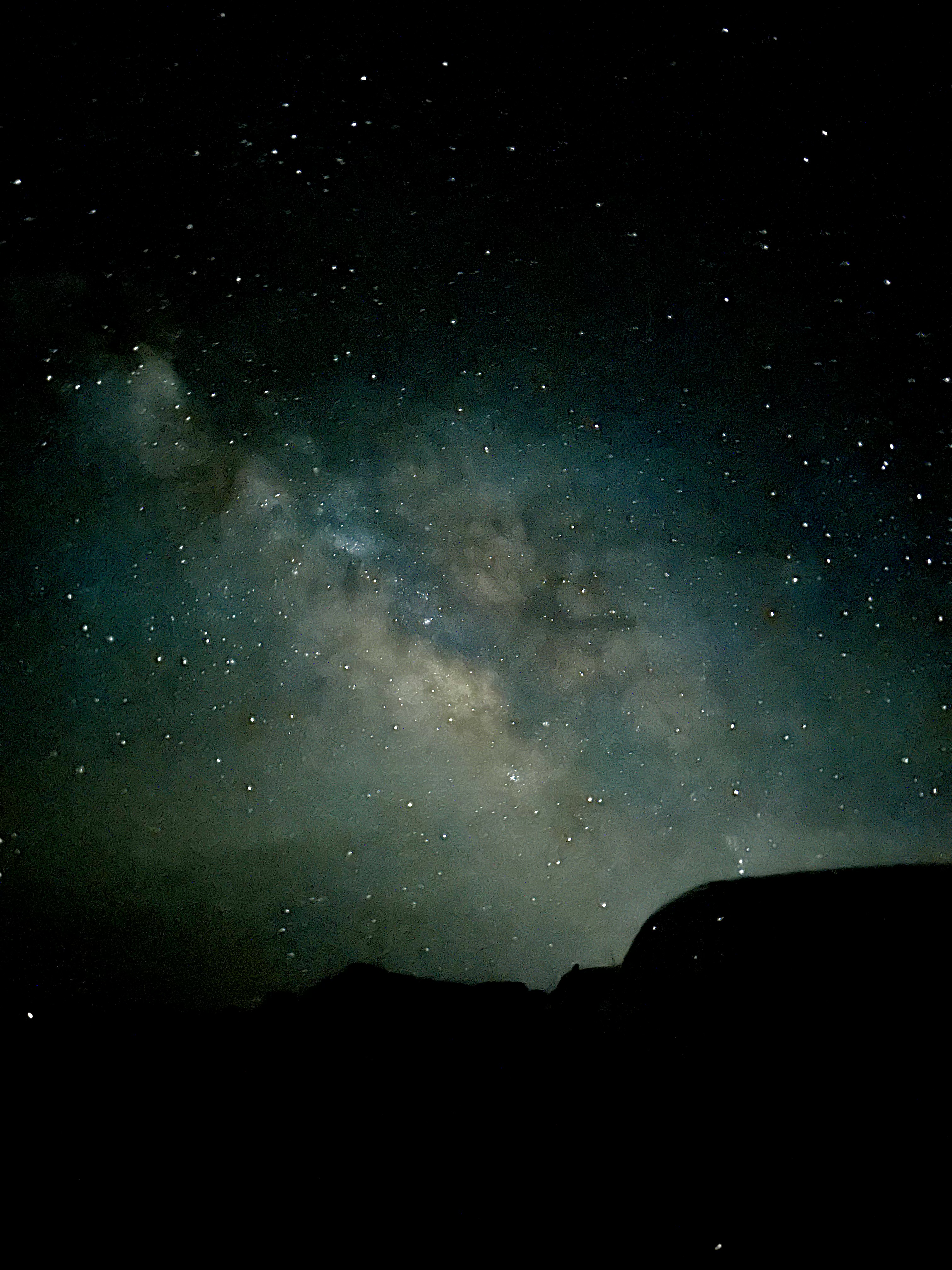
Just make sure to keep your lights off when driving in and out. Some even lay right on the sidewalk in front of the parking spaces. That is where I got this shot of the Milky Way.
Directions: Drive down the main park road for 10 miles before turning into the parking lot for Panorama Point. The parking lot will be on the right if you come from the park entrance.
2. Windows Section
This park area is known for its iconic arches, such as the Turret Arch, North Window, and South Window. The open spaces and unobstructed views make it an excellent location for stargazing, especially if you’re interested in capturing the silhouette of the arches against the starry sky.
You can enjoy hiking the Windows Section 1.2 mile trail, which provides beautiful areas to stargaze. Follow the trail to the Windows, bearing right at the first intersection, and near the top of the ridge, leave the trail to visit the Arch.
It does get busy here! So make sure to arrive early.
Directions: Drive the main park road for 9 miles before turning right ontoWindows Road. Continue for 2.4 miles to the trailhead parking areas.
3. Delicate Arch
Delicate Arch is the most famous sandstone arch in Arches National Park. It is even featured on Utah’s license plates. It is a fantastic place to stargaze from the top or lower on the trail.
Want to explore Arches during the day? Check out my Guide to Hiking Delicate Arch, one of the park’s most iconic landmarks
The delicate arch hike is 3 miles long, so you can walk 1.5 miles to the top at sunset and stay for the stars. Just be careful hiking back down, as there are some steep sections.
Tip: don’t forget your headlamp!

If you want to avoid the steep sections, you can view the stars from the parking lot of Delicate Arch, which is about 0.5 miles in; the trail is still flat here.
Directions: Enter the park and follow Arches Scenic Drive for about 12 miles. Turn right onto Delicate Arch Road and drive 1.2 miles to the Wolfe Ranch parking lot—this is the Delicate Arch Trailhead .There are two parking lots, but they fill up fast. Arrive early, especially at sunrise or sunset!
4. Devil’s Garden
Devil’s Garden has several impressive arches, including Landscape Arch, Double O Arch, and Partition Arch. This area offers vast views of the desert landscape and minimal light pollution, making it an excellent spot for stargazing and astrophotography.
You can do the famous, challenging hike with incredible views of unique arches, including Landscape Arch, one of the most extended natural spans in the world.
The hike is 7.9 mi with an elevation gain of 1,085 ft. If you are up for the challenge, ensure you are near the bottom at sunset. Or hike a half mile in to soak up the sky.
If you want to camp during your trip to Moab, this is the place to do it. Devil’s Graden Campground is the only campground in the park made for star lovers.
Directions: Drive 16 miles on the main park road until you see the signs for Devil’s Garden Road. You will see signs for hiking trails and Campgrounds.
5. Balanced Rock
Balanced Rock is one of the most recognizable features in Arches National Park, providing a dramatic backdrop for stargazing.
I would avoid the Balanced Rock parking area for stargazing since many people drive by. Instead, make your way to the picnic area just across the street. Here there will be less light pollution.
Directions: Follow the main park road for 8.7 miles. You will see the road for Willow Flats, which is across the street from the Balanced Rock parking area.
Arches National Park Dark Sky Programs
Attending a Dark Sky Program has been on my National Park bucket list for a while. I was fortunate to participate in one at Arches National Park this past summer. You park at Panorama Point at sunset and meet in the tiny little park.
The ranger will be set up in a small seating area. The area gets bustling, so bringing your chair or blanket could help. Many even set up their telescopes.
I love this Travel-sized Blanket for stargazing on my national park trips. It is easy to throw in a packet or suitcase.

The National Park Ranger taught us all about the stars we were seeing and even pointed out the Milky Way with a small laser pointer. It was so educational. After the program, you can also admire the stars at your own pace.
You can review the ranger-led stargazing events here.
Is It Free To Stargaze At Arches National Park?
Stargazing at Arches National Park and attending the Dark Sky Programs are free. However, there is a fee to enter the Park.
I recommend getting the America The Beautiful Pass, which allows you and your car unlimited access to the US National Parks for one year!
The Best Times To Stargaze At Arches National Park
The best times of year for stargazing at Arches National Park are when the skies are clear, and there is minimal light pollution. Here are the best times of year for stargazing at Arches National Park:
The period from late spring through early fall (May to September) typically offers the best stargazing conditions at Arches National Park. During these months, the weather is generally warmer and drier, with clear skies and minimal precipitation, providing excellent night sky visibility.
Stargazing during the new moon phase, when the moon is not visible in the sky, is ideal for observing galaxies, star clusters, and nebulae. The absence of moonlight enhances the contrast and visibility of these objects against the dark sky.
Arches isn’t the only great place for night sky viewing! Check out my guide to Stargazing in Great Basin National Park.
What Equipment Do I Need for Stargazing?
You don’t need anything! Let your eyes adjust to the night sky; the stars will look as vibrant as the photos.
I did not use any special camera to take the shots of the sky. I just turned on my iPhone and let the sky do the rest of the work.
You can use this Professional Monocular-Telescope to zoom in more and admire the planets.
Phone Tips For Photographing The Stars
Exposure: Experiment with different exposure settings to find the optimal balance between capturing enough light and avoiding overexposure. Start with a lower ISO setting (e.g., ISO 400 or lower) to minimize noise in the image, then gradually increase it if needed.
Use a Tripod: Stability is crucial for capturing sharp, clear night sky photos. Use a tripod or another stable surface to keep your iPhone steady during long exposures. If you don’t have a tripod, prop your iPhone against a stable object or use a makeshift support.
I recommend getting this Phone Tripod. It will help keep the photograph stable so you can take long exposures.
Set Focus to Infinity: Tap on a bright star or distant light source in the sky to manually set the focus to infinity. This ensures that distant cosmic objects are in focus and reduces the chances of blurry photos.
Where Is Arches National Park Located?
The National Park is located in Utah near Moab. My tip would be to put your stargazing destination in your GPS before entering the park. You will have no service in the area, and it can be challenging to see at night, thanks to the minimal light pollution.
Arches National Park Travel Guides
There is so much more to do when visiting Arches National Park!
I would spend the day hiking or viewing Delicate Arch. Here is Your Guide To The Delicate Arch in Arches National Park.
After hiking all day, book a reservation at Desert Bistro: The Best Restaurant In Moab
Looking for a place to stay? Here are 5 Amazing Hotels Near Arches National Park.
You can also check out my Stargazing In Great Basin National Park in Nevada guide!


Where Do You Want To Travel Next?